Showing posts with label The Guardian. Show all posts

Thursday, March 31, 2016

Canada's Prince Edward Island ends abortion ban in province

http://www.theguardian.com/world/2016/mar/31/canada-prince-edward-island-ends-abortion-ban
After a decades-long battle by pro-choice groups, Canada’s Prince Edward Island will abandon a policy that saw the province become the only one in the country where women cannot access an abortion.
Wade MacLauchlan, the Liberal premier of PEI, announced plans on Thursday to build a reproductive health centre on the island that will offer medical and surgical abortions, among other services. The aim is to begin providing abortions by the end of the year. 
The issue has been a flashpoint for decades in the province, where advocates say the last abortion was carried out in the early 1980s. In 1988, after Canada’s supreme court struck down the federal criminal law on abortion, PEI passed a resolution opposing abortions in the province.
In January, a pro-choice group took the government to court, arguing that the province has an obligation to provide unrestricted, publicly funded abortions. On Thursday, MacLauchlan said that while many in his cabinet and caucus have differing opinions on abortion, the government realised it likely would not be able to defend itself against the legal challenge and had been forced to change course. 
The news was celebrated by pro-choice advocates on the island. “I’m just elated,” said Ann Wheatley. “It’s been a really long, hard struggle and this is a very satisfying day.”
For decades women in PEI would have to get a referral from a doctor in PEI to travel to the neighbouring province of Nova Scotia for the procedure or foot the cost of having an abortion at a private clinic off the island. 
Those who couldn’t make the journey at times made desperate decisions, said Wheatley, with some trying to induce abortions by ingesting chemicals or being punched in the stomach. “There have been stories of women who have gone through extreme hardship to get an abortion.” 
In June, the provincial government said it would pay for abortions carried out in the neighbouring province of New Brunswick. But it remained obstinate about providing access to abortions on the island. “It really sent the message that there was something wrong with abortion and gave it an aura of shame and stigma that really affected women and affected access to abortion,” said Wheatley.
Thursday’s announcement was welcomed by Prime Minister Justin Trudeau. “A woman’s right to choose is a fundamental right in our country,” he said in a statement. “The Government of Canada reaffirms its belief that a woman should have access to reproductive health services, no matter where they live in our country.” 
The prime minister’s support for abortions came as the issue dominated the daily coverage of the US presidential election, after Republican frontrunner Donald Trump said in a TV interview on Wednesday that abortion should be illegal and the women who undergo the procedure should face punishment. He later attempted to recant, saying that only those who perform abortions should be held legally responsible.

Mexico turning child migrants back to face violence in Central America

Vulnerable children fleeing gang-fuelled violence in Central America are routinely deported by Mexican immigration officials regardless of the dangers they may face on their return home, according to a new Human Rights Watch (HRW) report.
Less than 1% of children detained in Mexico are accepted as refugees, even though about half are running away from criminal gangs in Central America’s violent northern triangle.

Sunday, January 10, 2016

Canadian prime minister Justin Trudeau condemns attack on Syrian refugees

Syrian refugees, including children, were pepper-sprayed during an event at a Muslim centre in Vancouver, an incident police are treating as a hate crime
Canadian Prime Minister Justin Trudeau on Saturday condemned an attack on Syrian refugees who were pepper-sprayed during a welcome event in Vancouver, an incident police are treating as a hate crime.
The group of newly arrived Syrians, which included children, was sprayed by an unknown bicyclist as they gathered outdoors on Friday for a welcome function at the Muslim Association of Canada Centre, Vancouver police said.
“This isn’t who we are – and doesn’t reflect the warm welcome Canadians have offered,” Trudeau wrote on Twitter on Saturday.
“I condemn the attack on Syrian refugees in Vancouver.”
Police said “a number of people” were treated by paramedics and the Vancouver fire and rescue service for pepper spray exposure.
Public broadcaster CBC said up to 30 people were affected.
“Although the motive for the pepper-spraying is unknown at this time, investigators are treating it as a hate-motivated crime, until determined otherwise,” the Vancouver police department said in a statement.
Vancouver mayor Gregor Robertson tweeted that the incident “was a disgusting display of hate – and Vancouver won’t stand for it.”
VPD is carrying out an investigation and searching for the perpetrator, who is thought to have been wearing a white hooded sweatshirt.
No arrests have been made, it said.
“This is an act of cowardice condemned by all Canadians of conscience,” board chair for the National Council of Canadian Muslims, Kashif Ahmed, said in a statement.
The Canadian government said it welcomed more than 6,000 Syrian refugees by the end of 2015 but fell short of its pledge to take in 10,000. It vowed, however, to meet that target in January.
Canada takes in an average of 250,000 refugees from around the world each year.

Thursday, January 7, 2016

Ex-Guatemalan officials arrested over civil war killings and abuses

Guatemalan prosecutors have announced the arrest of more than a dozen former military and government officials for alleged crimes against humanity committed during Guatemala’s civil war, and initiated human rights proceedings against an ally of President-elect Jimmy Morales.
Among the 14 people detained was Benedicto Lucas Garcia, a former army commander credited with founding paramilitary groups during the 1960-1996 conflict. He is also the brother of the late president Fernando Romeo Lucas García, who ruled Guatemala with an iron fist from 1978 to 1982.
Also detained were retired general Francisco Luis Gordillo, who helped bring former dictator Jose Efrain Rios Montt to power from 1982 to 1983, and Byron Barrientos, who was interior minister during the 2000-2004 presidency of Alfonso Portillo.
The suspects face charges of crimes against humanity involving massacres and disappearances of people by security forces under their command. They were ordered held in a military base prison ahead of a court hearing expected Friday. 
“The cases that we have documented were (attacks) against the non-combatant civilian population including children,” attorney general Thelma Aldana said. She described them as among “the largest forced disappearances in Latin America”.
Guatemalan media broadcast images of the former officials in handcuffs, some of them crying and saying their work during the war only involved fighting guerrilla bands.
“If I killed, I killed in combat, leading my troops and not as a coward or anything like that,” Lucas told reporters at the courthouse.
Prosecutors also moved to have the immunity of office lifted for Edgar Justino Ovalle, a member and co-founder of the party of Morales, who is scheduled to be inaugurated as president next week. As a sitting congressman, Ovalle is not subject to criminal prosecution unless lawmakers vote to end his immunity.
Peace accords brought an end to the 36-year civil war in 1996. Government security forces have been blamed for the vast majority of the 245,000 killings and disappearances during the conflict.
The detentions involve incidents such as the 1982 massacre at Plan de Sánchez, Baja Verapaz department, in which soldiers and militia members tortured, sexually abused and killed local residents.

Violent deaths in El Salvador spiked 70% in 2015, figures reveal

At least 6,657 people were violently killed in the Central American country, making last year the most violent since the height of 1983 civil war

El Salvador saw a 70% spike in violent deaths in 2015, making last year the bloodiest since the country’s civil war, according to figures released on Monday by the country’s authorities. 
At least 6,657 people were violently killed in 2015, amid a rise in mass killings and escalating violence between alleged gang members and police in the Central American country.


The overall murder rate rose to 104 per 100,000 habitants, compared to 1 per 100,000 in the UK and 90 per 100,000 in Venezuela – the second most murderous country in 2015. El Salvador has a population of approximately 6.4 million.
August was the most violent month, with more than 900 killings, including an unprecedented 52 deaths registered in a single day. The population of El Salvador is around 6 million.
Last year’s death toll is the highest recorded since 1983, at the height of a 12-year civil war that pitted a US-backed military dictatorship against leftwing guerrilla groups.
That conflict left an estimated 75,000 people dead, 1m displaced and thousands more disappeared, according to the UN Truth Commission.
A peace deal in 1992 led the guerrillas to disband but never resolved underlying problems of inequality and weak institutions, and the violence has continued.
Authorities routinely blame the current killings on warring street gangs involved in territory disputes and extortion rings. Murders fell by half after the 2012 government negotiated truce between the two biggest street gangs Calle 18 and Mara Salvatrucha 13, and have soared since the pact unravelled in 2014.
But growing evidence has emerged of extrajudicial killings carried out by police against alleged gang members.
Forensic experts have described other cases from 2015 in which alleged armed gang members were actually shot in the back. But investigators are not permitted to carry out independent ballistics investigations in police killings as this remains the jurisdiction of the National Police (PNC).In March, eight unarmed people weresummarily executed by police at the San Blas farm, about 18 miles south of the capital, San Salvador, according toa damning exposé by respected investigative news website El Faro. The scene was tampered with to make it seem that the victims had died in a gun battle as claimed by the police, the investigation found.
Steven Dudley, co-director of InSight Crime, told the Guardian: “The end of the truce caused a series of ruptures in both the gangs and the security forces. The gangs fragmented and the security forces radicalized and have begun using extra-judicial means to deal with the gangs.”
At times in the past year, parts of El Salvador have resembled war zones, as 6,000 soldiers were deployed on the streets alongside 23,000 police officers. Truckloads of masked security forces armed with machine guns patrol carry out house to house searches, looking for gang members.
In August, the capital came to a standstill as terrified workers were forced to stay home after gang leaders orchestrated a forced public transport boycott by killing a dozen bus drivers in response to a crackdown by authorities against organised crime.
A string of improvised explosive devices (IEDs) and hand-grenade attacks targeting police and government buildings added to the terror.
The current violence is mostly concentrated in cities and semi-urban areas, but the gangs are rapidly and violently expanding into even the smallest rural communities in order to run extortion rings and control territory.
Celia Medrano, chief programme officer at the human rights group Foundation Cristosal, told the Guardian: “We’re living with the same levels of human drama that we did during the 80s, but the level of insecurity and fear is actually worse because violence is spread across the country.”

Guatemala's Volcano of Fire erupts, sending ash 7km into the sky

The active Fuego volcano near Guatemala City has been spewing lava and sending ash raining down on towns in its vicinity
Guatemala’s Fuego Volcano has erupted in dramatic fashion, sending columns of ash 7km (4m) into the sky.
No evacuations were ordered due to Sunday night’s volcanic activity. But officials asked nearby communities to remain vigilant and Guatemala’s Volcanological Institute has advised aviation authorities to ensure flights do not come into contact with the ash cloud.
The institute said the mountain, whose name translates to Volcano of Fire, produced “constant sounds similar to a train locomotive and strong explosions” that rattled roofs and windows 30km away.
National disaster response spokesman David de Leon said on Monday that particulate matter was falling in at least eight nearby towns.
The eruption, which began last week and has intensified over recent days, created some striking images.
The volcano, which lies about 50km southwest of Guatemala city, stands some 12,300 feet above sea level in south-central Guatemala. It erupted 13 times last year.
In February 2015, the volcano experienced a powerful eruption that prompted the closure of the capital’s airport.

Tuesday, December 15, 2015

Colombia's government and Farc rebels reach agreement in step to end civil war

Representatives of the government and leftwing rebels strike a deal in Havana on reparations for victims and the establishment of special tribunals
Representatives of Colombia’s government and leftwing Farc rebels have taken another major step towards reaching a deal to end the world’s longest-running civil war, with an agreement on reparations for victims and the establishment of special tribunals to try former combatants
The agreement, marked on Tuesday with a ceremony in Havana, helps put peace talks back on track toward reaching a 23 March deadline for a comprehensive plan to end the conflict which has killed 220,000 people and displaced millions since 1964.
“We’ve never been so close to a definitive agreement before,” Colombian President Juan Manuel Santos wrote on Twitter.
The partial agreement was the result of 18 months of work in which victims of the rebels, government troops and right-wing paramilitary groups participated and offered proposals. Sixty of them gave testimony to peace negotiators in Havana, site of the peace talks for the past three years.
The accord creates a truth commission to clarify what happened in the war and promises to search for thousands of missing people, identify their remains and return them. It also attempts to ensure those affected will not be victimized again.
A group of war victims invited to the ceremony gave a cautious welcome to the agreement. “But it doesn’t mean that we renounce our demand for justice reparations and truth,” said Jineth Bedoya, a journalist who was abducted twice by rightwing paramilitaries.
Luis Mendieta, a retired army general who spent eleven years, seven months and 13 days as a hostage of the Farc said that the full details of the latest agreement had still not been released. “But if it brings us closer to peace, it is a good thing.”
Alan Jara, who was chained to Mendieta for much of the seven years and seven months that he was in the hands of the Farc, said he was shocked to see the person who organised his kidnapping among the Farc delegation. “I couldn’t believe it,” he said.
“It is the people who haven’t suffered directly the ones who are least willing to accept a peace deal,” says Jara. “We who lived it are more accepting.”
In September, the Colombian government and the Farc reached a breakthrough agreement to establish special courts to try former combatants, including guerrillas, government soldiers and members of right-wing paramilitary groups.
While attempting to offer as much amnesty as possible, the courts would reduce sentences for those who admit guilt and exclude from amnesty those responsible for war crimes or crimes against humanity.
Judges on the special tribunal will not be chosen by either side of the negotiating table.
Tuesday’s agreement formalizes the new justice system, which has caused consternation in Colombia, where critics complain Farc members might escape punishment or extradition to the United States, where some are wanted on drug-trafficking charges.
“We hope the implementation of these and all of the accords will ensure dignity for the victims, do justice, and lay the foundation for ending the violence of the conflict in our country once and for all,” the two sides said in a joint statement.
Talks will resume in January, taking on the issue of how the rebels will demobilise and decommission their arms. A member of the commission that has been working on the issue said the two sides were “halfway there”.

Wednesday, November 11, 2015

Brazilian Dam Bursts Killing At Least 15 People

A dam that burst at an iron-ore mine in south-eastern Brazil on Thursday is thought to have killed at least 15 people, devastating a nearby town with mudslides and leaving officials in the remote region scrambling to assess casualties.
Forty-five people were still missing after the disaster at the Germano mine near the town of Mariana in Minas Gerais state, a local union told the G1 news portal.
The mine is operated by Samarco, a joint venture between the Anglo-Australian mining giant BHP Billiton and the Brazilian company Vale.
Andrew Mackenzie, the chief executive of BHP, said in Melbourne: “Most of what happened there has been under the cloak of darkness.
“At daybreak, clearly we will do an awful lot more and give you further updates.”
The company would “take all steps” to ensure the safety of the workers and communities affected by the disaster.
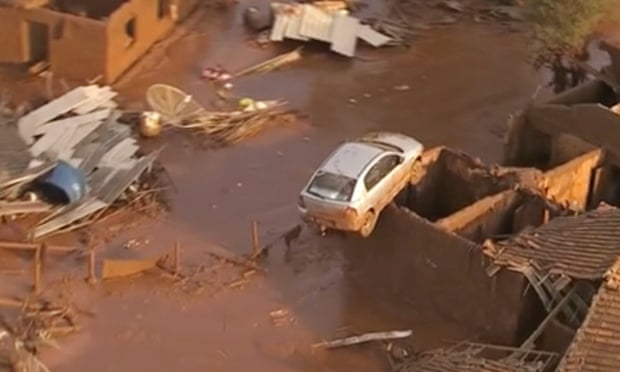
Cars and homes were destroyed after an iron mine dam burst in Minas Gerais state.
Pinterest
Cars and homes were destroyed after an iron mine dam burst in Minas Gerais state. Photograph: Oglobo
Video footage on the G1 website showed houses of a village destroyed by flood waters and clay-red mud that surged down valleys in the mountainous region. Large vehicles lay tossed on their sides.
There was no official confirmation on the total number of dead and missing. A city hall official confirmed one death and 16 injuries, adding that dozens more were still missing.
Civil defence authorities in Mariana said they were evacuating about 600 people to higher ground from the village of Bento Rodrigues, about 7km (just over 4 miles) beneath the dam that burst, which was flooded as a result of the accident.
Television footage showed dozens of homes destroyed by the mudslide. A car rested on top of a wall where the roof of a building had been ripped off.
Authorities said the flood had also reached another village further down the hill, Paracatu de Baixo, and that inhabitants there were also being evacuated.
Rescue crews continued to search the muddy waters after nightfall. Brazilian army units nearby stood ready to help the search and rescue effort and the minister of national integration, Gilberto Occhi, planned to visit the state on Friday to provide assistance, according to a note from the presidency.
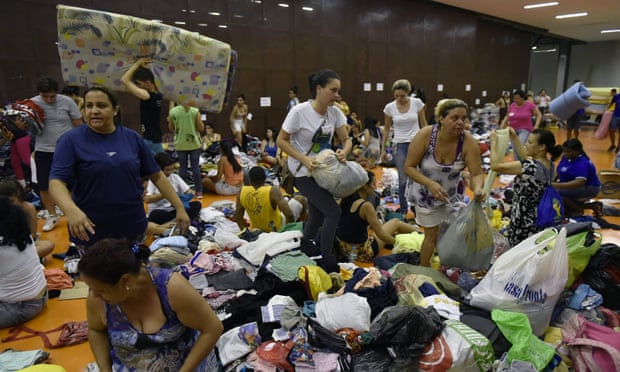
People gather at the Arena Mariana, in Mariana, after a dam burst, forcing residents from their homes.
Pinterest
People gather at the Arena Mariana, in Mariana, after a dam burst, forcing residents from their homes. Photograph: Douglas Magno/AFP/Getty Images
Samarco said in a statement it had not yet determined why the dam burst or the extent of the disaster.
BHP Billiton said in a statement that it was “concerned for the safety of employees and the local community ... We are in the process of obtaining more details from Samarco Mineracao.”
Vale directed media questions to Samarco.
Authorities said the dam was built to hold back water and residue from mining operations, a mixture that can often be toxic. The dam was holding so-called tailings, a mining waste product of metal filings, water and occasionally chemicals. It was located near the Gualaxo do Norte river, fuelling fears of potential water contamination.
Rescue teams were searching for survivors or bodies, and residents living nearby were told to evacuate to higher ground.
Site of the burst dam in Minas Gerais state.
Samarco said in a statement on its website that it was making “every effort to prioritise care to people and mitigate damage to the environment”.
“It is not possible at this moment to confirm a cause,” it added.
A statement from the city hall of Mariana, a city of about 40,000 people 300km (185 miles) north of Rio de Janeiro, said the dam ruptured at 4.20pm in an area roughly 20km from the city centre.
The disaster comes as both Vale and BHP are battling a collapse in iron ore prices and a wider slump in the industry.
The Germano mine is a 50-50 joint venture between the world’s largest iron miner and the largest mining company.
Iron ore is transported down a slurry pipe to Espirito Santo in south-eastern Brazil, where it is turned into pellets. Samarco produces around 30 million tonnes per year, according to its website.
Associated Press and Reuters contributed to this report.

Sunday, November 8, 2015

Mexican drug lord El Chapo escapes prison – in pictures

Argentina on alert after tip about escaped drug lord 'El Chapo'
Argentinian authorities receive word that Joaquín Guzmán, who escaped Mexican prison in July, may be hiding along mountainous border with Chile
 
Joaquín Guzmán, the world’s most wanted drug trafficker, escaped in July from a Mexican maximum-security prison through a mile-long tunnel that surfaced right inside his cell. Photograph: Eduardo Verdugo/AP
 
Argentina is on high alert after getting a tip that escaped Mexican drug boss Joaquín “El Chapo” Guzmán may be somewhere along the country’s mountainous southern border with Chile, the country’s security security said on Friday.
Guzmán, the world’s most wanted drug trafficker, escaped in July from a Mexican maximum-security prison through a mile-long tunnel that surfaced right inside his cell, in a major embarrassment for the Mexican president, Enrique Peña Nieto.
There is a massive manhunt on in Mexico for El Chapo, aka “Shorty”, head of the powerful Sinaloa cartel which has smuggled billions of dollars worth of cocaine, marijuana and methamphetamines into the United States and fought vicious turf wars with other Mexican gangs.
“We received information that El Chapo tried to cross the Chilean/Argentine border,” in the southern region of Patagonia, the security secretary, Sergio Berni, told reporters.
“In line with protocol, we have activated all security mechanisms and have put the men and women of our federal forces in Patagonia on maximum alert,” Berni said.
An official source in Chile, who asked not to be named, told Reuters that “since mid-day the government has been receiving and collecting information on the matter”.
In August, the acting head of the US Drug Enforcement Administration said the US government believed Guzmán was still in Mexico.
Guzmán narrowly evaded security forces searching for him in the north-west of Mexico in October, sustaining injuries to his face and leg, the Mexican government said last month.
His brazen escape piled pressure on Peña Nieto to root out corruption, at a time when the Mexican leader is grappling with conflict of interest scandals plaguing him, his wife and his finance minister.

Thursday, March 12, 2015

Mexican Mayoral Candidate Found Dead

The body of a woman running for election as mayor of a small Mexican town has been discovered after she was kidnapped and reportedly decapitated in the same region where 43 student teachers disappeared last year.